
May 12, 2025
By Mike Crispen
“You’ve felt it, haven’t you?”
That subtle tension when reading Scripture—like there’s something bigger going on beneath the surface. A hidden war. A pattern repeating. Genesis echoes in the Gospels. Job whispers in the shadow of the cross. And when Jesus cries out, “My God, my God, why have you forsaken me?”—you suspect He’s saying more than just a line of despair. It’s as if the whole Bible is one cosmic drama, but no one ever handed you the program.
And so you dig. You start tracing themes—scattering and gathering, innocent suffering, Satan’s limited permission, the divine council, cosmic justice—and suddenly, it clicks: this isn’t just a collection of stories. It’s a war story. It’s a rescue operation. It’s a reversal of evil’s plan, carried out in plain sight.
That’s what this article is about: showing you how the cross isn’t just the climax of salvation history—it’s the moment Satan fell into his own trap. It’s when Jesus, like Job, suffers unjustly and then rises in vindication. It’s when Psalm 22’s lament explodes into a declaration of global victory. And it’s when the nations, once scattered in Babel, begin to be reclaimed—not through conquest, but through crucified glory.
You’re about to see how this all fits together—Genesis, Job, Psalm 22, the Gospels, and beyond—as one unified story of cosmic redemption. Let’s trace the battle map.
The Big Setup: From Eden to Babel to the Divine Council
The story starts with a mission.
Genesis 1:28 spells it out clearly: “Be fruitful and multiply and fill the earth and subdue it…” Humanity was commissioned to spread out, to steward creation, and to reflect God’s image across the world. But instead of multiplying and filling the earth, humanity consolidates, builds upward, and seeks to make a name for itself (Genesis 11:4). It’s not just disobedience—it’s defiance. A direct reversal of Eden’s purpose.
This rebellion leads to the Tower of Babel, and Babel is more than a cautionary tale about pride. It’s a turning point in how God relates to the nations.
Here’s where things get interesting.
In Deuteronomy 32:8–9, we read (in the Septuagint and Dead Sea Scrolls versions):
“When the Most High gave to the nations their inheritance, when He divided mankind, He fixed the borders of the peoples according to the number of the sons of God. But the LORD’s portion is His people, Jacob His allotted inheritance.”
This isn’t just about geography. It’s about governance.
Humanity is scattered, and the nations are placed under the authority of spiritual beings—often referred to as the “sons of God” (see also Job 1:6 and Psalm 82). But these divine beings, rather than ruling justly, rebel. Psalm 82 accuses them directly:
“You are gods, sons of the Most High, all of you; nevertheless, like men you shall die…” (Psalm 82:6–7)
This is the divine council worldview: God, in response to Babel’s rebellion, disinherits the nations and assigns them over to spiritual rulers—who themselves become corrupt. It’s a layered judgment—on both human and supernatural levels.
But God doesn’t abandon the world. He calls one man—Abraham.
Deuteronomy 32:8–9 (LXX/DSS) offers the cosmic consequence:
The nations are scattered and handed over to divine beings—“sons of God”—who, according to Psalm 82, later rebel. This sets the stage for a fractured world under corrupt spiritual rulers.
Abraham: God’s Response to Rebellion
When humanity is scattered and the nations are placed under lesser spiritual rulers, it can feel like the story should end there—judgement rendered, humanity fractured, divine order compromised. But God’s response isn’t retreat. It’s redemption.
Enter Abraham.
“Now the LORD said to Abram, ‘Go from your country and your kindred… and I will make of you a great nation… and in you all the families of the earth shall be blessed.’”
(Genesis 12:1–3)
This is the pivot point. Abraham is not just the father of Israel—he is the beginning of God’s campaign to reclaim the nations He disinherited at Babel. Through one man, God begins a new creation project. It’s a strategic counter to the cosmic fracture.
And Paul sees this clearly. In Galatians 3:8, he writes:
“And the Scripture, foreseeing that God would justify the Gentiles by faith, preached the gospel beforehand to Abraham, saying, ‘In you shall all the nations be blessed.’”
Abraham is a second Adam. Where the first Adam brought death to the world, Abraham’s seed will bring life. Where Babel created division, Abraham’s lineage will bring reconciliation. The call of Abraham isn’t just the beginning of Israel—it’s the blueprint for global restoration through Christ, the promised Seed (Galatians 3:16).
And through this lens, the whole Old Testament becomes a slow-motion plan of reclamation. The God who scattered now gathers. The God who judged now blesses. The nations who were handed over are now being invited back—one covenant, one promise, and one Messiah.
Job: More Than a Moral Tale
For many readers, Job is simply about personal suffering. A good man gets caught in a cosmic test, loses everything, and clings to God through the silence. But read through a typological lens—one that looks for patterns and echoes pointing forward—and Job becomes something much more: a prophetic shadow of Christ Himself.
The story opens not on earth, but in heaven:
“Now there was a day when the sons of God came to present themselves before the LORD, and Satan also came among them.”
(Job 1:6)
This echoes the divine council scene of Psalm 82 and reinforces the idea that spiritual beings are part of God’s administration over creation. Satan is not yet cast out—he appears as an accuser, a role we later see highlighted in Revelation 12:10.
God calls Job “blameless and upright” (Job 1:8). Satan challenges this, insisting that Job only worships God because his life is good. So God permits suffering—but with limits:
“Behold, all that he has is in your hand. Only against him do not stretch out your hand.”
(Job 1:12)
That line matters. Satan is allowed to afflict, but not to kill. There is divine restraint, a boundary that Satan cannot cross.
Fast forward to the Gospels: Jesus, too, is blameless. He, too, is tested and betrayed. But unlike Job, Jesus is killed—and in doing so, Satan breaks the pattern. The restriction that applied in Job’s story is seemingly violated. And that’s where the irony begins: in killing the innocent Christ, Satan sets the stage for his own undoing.
But the parallels don’t stop there:
- Job intercedes for his friends (Job 42:10), just as Christ mediates for us (Hebrews 7:25).
- Job’s restoration is double (Job 42:10)—a sign of resurrection glory (Philippians 2:9–11).
- And Job, like Jesus, remains faithful even when God seems absent.
In Jewish interpretive tradition, this is called remez—a hint, a whisper of something deeper. Job isn’t just a lesson in perseverance; he’s a type of Christ, pointing forward to the one who would suffer innocently, intercede for the guilty, and be vindicated by God.
Satan’s Fatal Error: Killing the Innocent
Satan’s defeat didn’t begin with the resurrection. It began the moment he thought killing Jesus was a win.
In Job, we saw God place a boundary: Satan could test Job, but not take his life. That restraint mattered. It was a declaration that ultimate authority remained with God, even amid suffering. But when we reach the Gospels, something changes. Jesus, the blameless one, is handed over and crucified. And Satan thinks he’s won.
But this is where the irony cuts deepest: in violating the very pattern he exploited in Job, Satan unwittingly falls into a divine trap.
Paul captures this perfectly:
“None of the rulers of this age understood this, for if they had, they would not have crucified the Lord of glory.”
(1 Corinthians 2:8)
Satan’s nature is to rebel. That’s been true from the beginning—he tempts, deceives, accuses, and resists divine order at every turn. So when God sends His Son in weakness, wrapped in flesh and destined for suffering, Satan does what Satan always does: he strikes. He manipulates the rulers, enters Judas (Luke 22:3), stirs up the crowd, and fuels the betrayal.
And God knew he would.
That’s the brilliance of the cross. God doesn’t just allow Satan’s rebellion—He anticipates it. He weaves it into the plan. The serpent thinks he’s crushing the seed, but in doing so, he ensures the fulfillment of Genesis 3:15:
“He shall bruise your head, and you shall bruise His heel.”
At the cross, the heel is bruised—but the head is crushed.
This isn’t just poetic symmetry. It’s the unveiling of what Paul calls “the mystery, hidden for ages” (Colossians 1:26). Satan’s rebellion becomes the vehicle of his own collapse. The powers of darkness gather to destroy Christ, only to light the fuse of their own downfall.
In trying to end the story, Satan launches its climax.
Psalm 22: A Battle Cry in Disguise
It’s easy to hear Jesus’ cry from the cross—“My God, my God, why have you forsaken me?”—as a moment of despair. It sounds like abandonment. It feels like defeat. But if you were a first-century Jew steeped in the Psalms, you’d know something else was happening.
This is not just anguish. It’s a reference. A coded message. A battle cry.
Psalm 22 opens with those exact words (v. 1), but it doesn’t end in hopelessness. It begins in darkness and confusion, yes—but by verse 27, the tone shifts dramatically:
“All the ends of the world shall remember and turn unto the LORD: and all the kindreds of the nations shall worship before thee.”
What starts as a lament ends in global worship. Jesus isn’t just crying out in pain—He’s invoking the entire arc of Psalm 22. In Jewish tradition, quoting the first line of a psalm was a shorthand for the whole. So when Jesus speaks those words from the cross, He’s not just expressing suffering. He’s declaring where this story is headed.
The kingdom is coming.
And that declaration would not be lost on anyone who knew the psalms. Psalm 22 also speaks of mockers at the foot of the cross (v. 7–8), pierced hands and feet (v. 16), the dividing of garments (v. 18)—explicit details that line up with the crucifixion accounts. Jesus is saying, You know how this song ends.
And it ends in victory.
This cry doesn’t mark God’s absence—it marks His plan being fulfilled in real time. It’s a trumpet blast to the unseen realm: “You’ve misread this moment. What looks like weakness is war. What feels like defeat is the beginning of your end.”
…So when Jesus quotes Psalm 22, He isn’t giving up. He’s announcing that the tables are turning, the nations are watching, and the serpent’s rule is about to collapse.
And there’s one more line that seals it:
“I will declare your name to my brothers; in the midst of the congregation I will praise you.”
(Psalm 22:22)
This is the hinge between lament and triumph. It’s picked up again in John 17:26, where Jesus says, “I made your name known to them, and will continue to make it known…” In other words, Christ’s mission wasn’t just to suffer—it was to proclaim the name of the Lord to the nations, reclaiming what Babel scattered and what Satan tried to silence.
Psalm 22 isn’t just Jesus’ cry—it’s His call to arms. A proclamation that this cross isn’t the end, but the beginning of global restoration.
The Harrowing of Sheol: Christ Reclaims the Dead
What happened between Good Friday and Easter morning?
The creeds say it plainly: “He descended to the dead.” But that line is often skipped past, like a footnote in the salvation story. In early Christian thought, though, this descent—what’s sometimes called the “Harrowing of Hell”—was anything but incidental. It was a critical part of Christ’s cosmic victory.
Let’s start with a strange phrase in Ephesians 4:8–10:
“When he ascended on high, he led captivity captive, and gave gifts to men… He who descended is the very one who ascended far above all the heavens, that he might fill all things.”
Paul’s alluding to a triumphant procession—Christ descending into the realm of the dead, not as a victim, but as a conqueror. He goes down to Sheol not to suffer, but to liberate.
This matches what we see in 1 Peter 3:19, where Christ “went and proclaimed to the spirits in prison.” The early church believed that Jesus didn’t just die for the living—He came to release the righteous dead as well, including the patriarchs who waited in hope.
Jesus even hints at this in the parable of the rich man and Lazarus (Luke 16:22–31), where the faithful dead reside in “Abraham’s bosom.” It’s a place of waiting. But after the cross, waiting ends.
“You will not abandon my soul to Sheol, or let your holy one see corruption.”
(Psalm 16:10; quoted in Acts 2:27–31)
Peter uses this in his Pentecost sermon to show that Jesus’ resurrection was foretold—and that His soul did descend, but wasn’t left there. Instead, He rises, and with Him, He brings captives up into freedom.
This isn’t just theology. It’s a jailbreak. A spiritual earthquake.
The descent into Sheol is the moment Christ declares His victory in the unseen realm. The crucified Messiah enters death’s domain not to be held, but to break its grip. He reclaims the faithful dead, reverses the curse of Adam, and walks out of the grave with keys in hand (Revelation 1:18).
After the Resurrection: Satan’s Authority Unplugged
When Jesus rises from the grave, He doesn’t just defeat death—He disarms the enemy.
“All authority in heaven and on earth has been given to me.”
(Matthew 28:18)
That’s a stunning declaration. Not some authority. Not eventual authority. All of it. It means the resurrection doesn’t just signal life after death—it signals a regime change. The enemy who once held the power of death (Hebrews 2:14) now holds nothing but bluster and borrowed influence.
Before the cross, Satan had real dominion. He was called “the ruler of this world” (John 12:31). But after the resurrection, his legal ground is gone. His power wasn’t stripped in a cosmic fistfight—it was unplugged at the source. The death and resurrection of Jesus cancelled the record of debt that empowered the accuser (Colossians 2:14–15), and with it, the leverage he used against humanity.
And here’s something deeply symbolic.
In the curse of the serpent in Genesis 3:14, God declares:
“Dust you shall eat all the days of your life.”
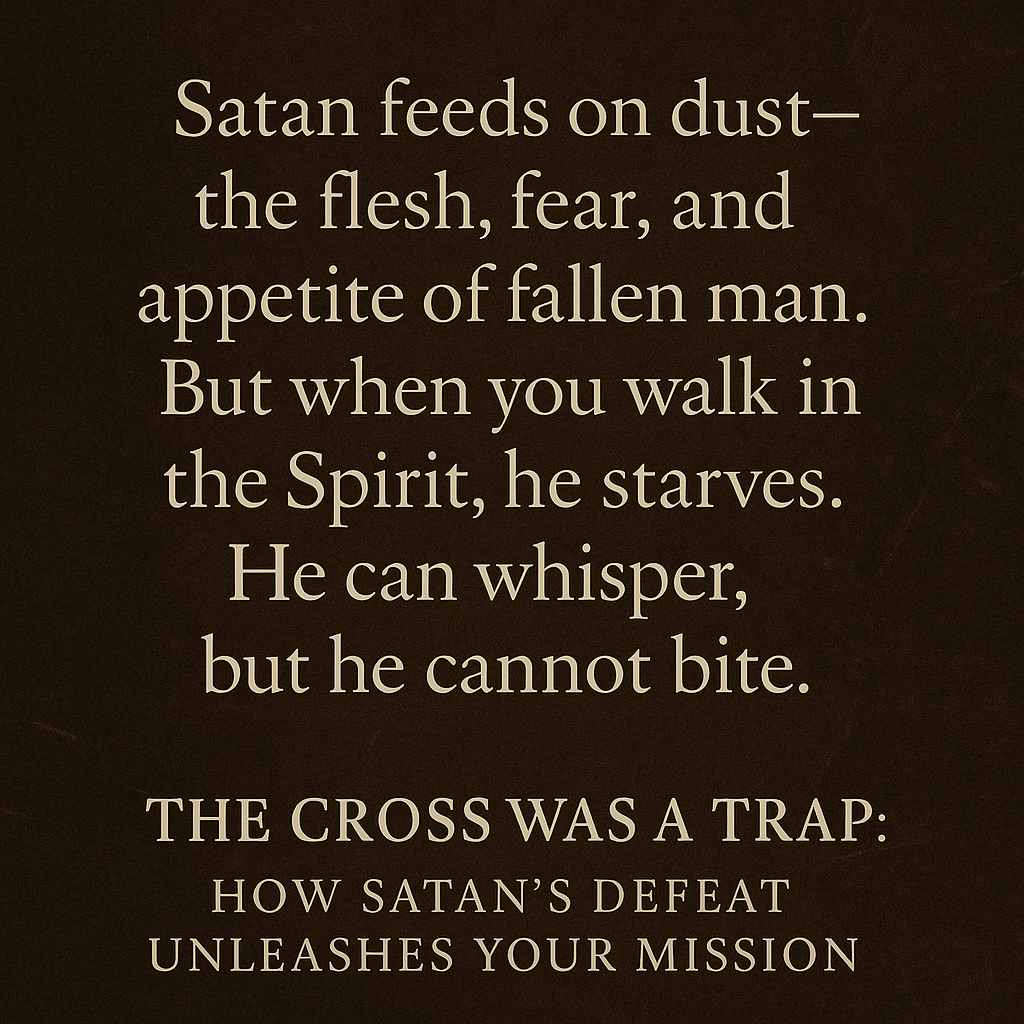
The Hebrew word for dust is ‘apar’—the same word used in Genesis 2:7 to describe the material God used to form man. Satan is sentenced to feed on the lowest aspect of human nature. And what is that dust made of? Survival instinct. Flesh. Lust. Fear. Self-preservation. The basest drives of fallen humanity.
The more a person lives from that dust—ruled by appetite, insecurity, ego—the more Satan finds something to feed on. But the closer someone draws to Christ, the more their life rises above that dust. The Spirit lifts them, and Satan starves. His hunger grows, but there’s nothing left to consume. No foothold. No agreement. No authority.
So post-resurrection, Satan is not just defeated—he’s famished. He prowls, yes (1 Peter 5:8), but he is powerless over those who walk in the Spirit and not in the flesh (Galatians 5:16–18). His power depends entirely on human cooperation with base instinct. Remove that—and he is silenced.
This means that in Christ, you’re not under Satan’s rule by default. You have to consent to it—through fear, compromise, or deception. That’s the only way he gains ground.
So what changed at the resurrection?
Everything.
Satan is now a trespasser. A squatter. He roars like a lion, but he’s been declawed. His only remaining weapon is your agreement—and your flesh, if you offer it. But walk in Christ, and Satan has nothing to eat.
Why This Changes Everything (for You)
This isn’t just theology—it’s strategy. A war map. A liberation blueprint.
Christ didn’t just die for your forgiveness; He dismantled the systems of darkness, crushed the serpent’s head, and called you into His victory campaign. The enemy now roams with no authority—only lies. His only access point is human agreement. And the way he gets it? He whispers the same lie he told in the garden: “You can define good and evil for yourself.”
And every time you cling to the things of this world—comfort, status, pleasure, survival—you hand him the dust he feeds on. You empower him to speak, to sow confusion, to muddy the name of the Lord.
But you weren’t called to fit into a broken world. You were commissioned to transform it.
“If you love me, keep my commandments.”
(John 14:15)
Jesus didn’t just say believe. He said follow. He didn’t just set you free from the curse of the Law—He handed you the sword of the Word. Paul says we are not “under the Law,” meaning we are no longer under its curse (Galatians 3:13), not that its instruction is void. Torah doesn’t just mean “Law”—it means teaching. It is the framework God gave His people to embody His name in the world.
Jesus didn’t abolish that framework—He embodied it. He fulfilled it, not so you could discard it, but so you could finally walk it out in freedom and power (Romans 8:4).
Satan’s greatest modern lie? That obedience is optional. That as long as you “believe,” you can live however you like. But what does “good” even mean if the Law no longer defines sin?
“I would not have known what sin was except through the law.”
(Romans 7:7)
To participate in this war—to fight, not just survive—you need to be intentional. Strategic. Trained.
You’re not called to be a spectator. You’re called to be a soldier.
So what should you do?
Feed His sheep. Follow His commandments. Study His Word. Train with your sword. And surround yourself with fellow warriors who refuse to live in the dust.
Pick up your sword. Sharpen it through study. Embrace the commandments. Gather the saints. And let out your battle cry:
“The God of peace will soon crush Satan under your feet. The grace of our Lord Jesus Christ be with you.”
(Romans 16:20)
Victory has already been won. But the war isn’t over. Now, it’s your move.
Message to the Thin Blue Line:
In this great spiritual war, those who stand between darkness and the innocent are not merely doing a job—they are echoing the call of Christ. The police officer who serves as that thin blue line reflects the Spirit of Michael, protector of the saints (Daniel 12:1), and the boldness of Elijah who answered, “Here I am—send me.” To lay down one’s life for another is not just honorable—it’s Christlike (John 15:13).
True officer wellness isn’t just found in physical tactics or mental toughness, but in spiritual clarity: knowing your mission, counting the cost, and anchoring your identity in the victory of Jesus. The officer who walks this path fights the right fight—and is more able to see light in a world that often feels like endless darkness. You are the beacon. You are the line. You carry the hope of heaven into the heart of the chaos.
This is the key to true mental wellness: not merely surviving the darkness, but understanding why you were sent into it.
 Thin Blue Faith
Leave a comment