
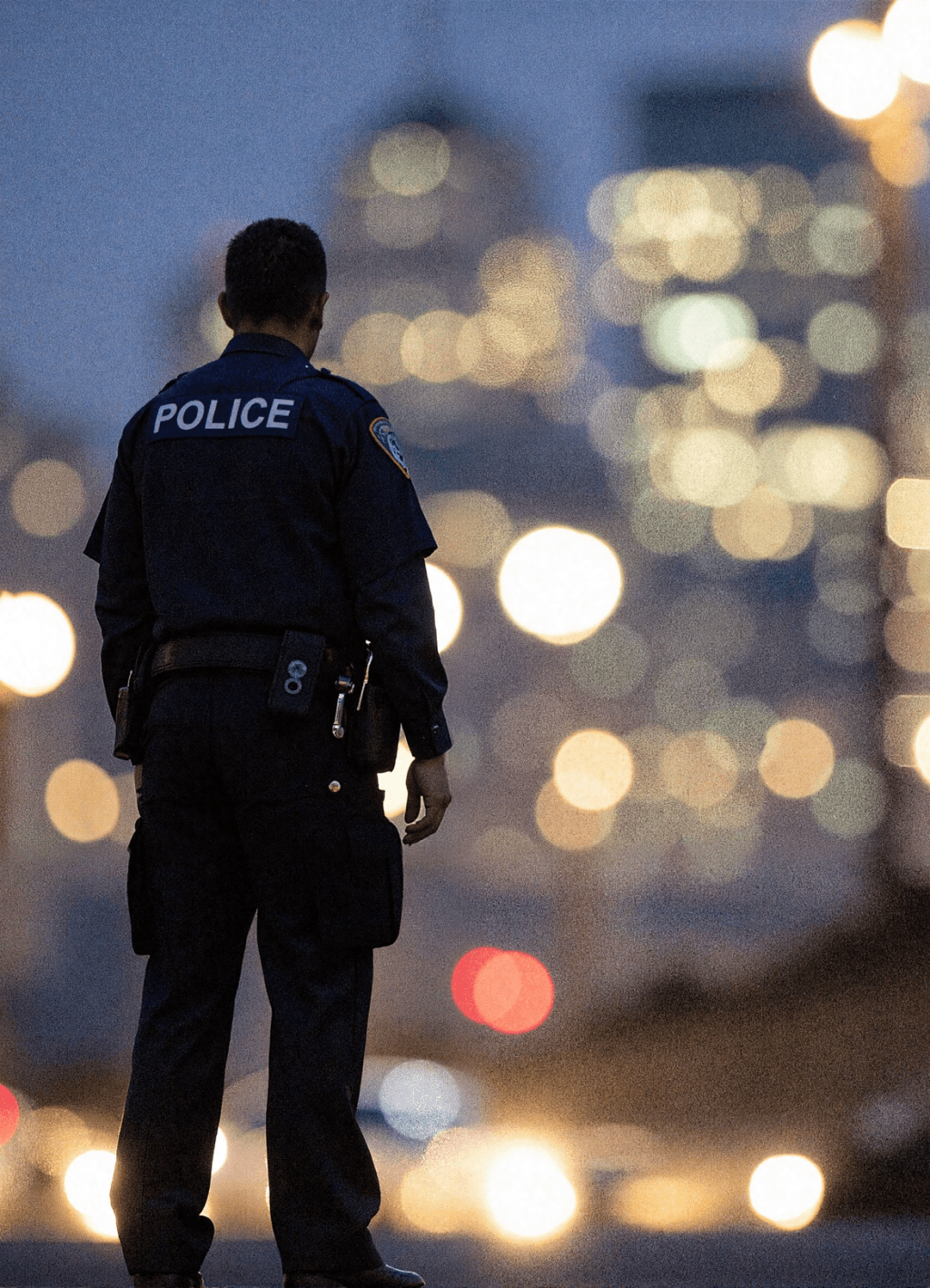
Reclaiming the Badge as a Sacred Trust—Where Justice, Faith, and Duty Meet
May 23, 2025
By Mike Crispen
Introduction
You didn’t swear an oath to a flag.
You didn’t swear an oath to a department.
You swore an oath to the Constitution.
That’s something you understood when you raised your right hand—maybe in a packed auditorium, maybe in a quiet ceremony surrounded by family. And in that moment, you weren’t just agreeing to wear a badge. You were stepping into something deeper: a promise to protect rights, not just enforce laws.
And now, maybe, you’re wondering where that line sits.
The world’s gotten noisy. The same public you swore to protect sometimes questions your every move. The Thin Blue Line, once a symbol of honor and sacrifice, has become a lightning rod—debated in courtrooms, on the streets, and across social media. What does it mean anymore?
Here’s what hasn’t changed: you still stand in the space between order and chaos.
But here’s what’s more important: you’re not just there to hold that line—you’re there to define how it’s held.
This article isn’t about politics. It’s not about public image. It’s about truth, duty, and justice—not the kind twisted by personal opinion, but the kind grounded in law and morality. The kind Scripture calls us to when it says:
“What does the Lord require of you? To act justly, to love mercy, and to walk humbly with your God.” — Micah 6:8
You’ll walk away from this article with a clear understanding of what the Thin Blue Line really means—where it came from, what it stands for, and how you can carry it with integrity in a world that desperately needs real justice.
From Red to Blue: The Origins of the Line
Before the Thin Blue Line, there was the Thin Red Line.
The phrase was first used in 1854 during the Crimean War. At the Battle of Balaclava, a small force of British infantry—clad in red uniforms—held their ground against a much larger Russian cavalry. War correspondents reported on the moment, calling it a “thin red line tipped with a line of steel.” It became a symbol of courage, discipline, and standing firm against overwhelming odds.
Fast forward to the 20th century, and American law enforcement began to adopt a similar metaphor. The Thin Blue Line replaced red with blue—the color of most police uniforms—and redefined the concept for a different kind of battlefield: city streets, neighborhoods, rural roads, and public spaces. It wasn’t about defending territory from foreign armies anymore—it was about defending society from lawlessness.
One of the most well-known champions of the phrase was LAPD Chief William H. Parker in the 1950s. He used it to describe officers as the barrier between a civilized society and chaos. Parker wasn’t romanticizing violence—he was highlighting restraint, discipline, and moral purpose. The Thin Blue Line was never about aggression. It was about standing firm, holding ground, and protecting what’s right.
In the decades since, the phrase gained traction—through memorials, emblems, documentaries, and department mottoes. It became a rallying cry for unity and sacrifice, especially in honoring fallen officers. But as the symbol spread, it also became more layered—and more debated.
That’s why this history matters. Because understanding where the line comes from helps us reclaim what it’s supposed to mean: not power, not pride, but protection. Not “us versus them,” but us for them—for the people, for the peace, for the promise you made when you put on that badge.
Thin Blue Faith:
The Thin Blue Line wasn’t meant to divide the public—it was meant to protect them.
The Oath: Upholding the Constitution
Every officer begins the job the same way: with a sworn oath. Words that are often recited quickly, maybe even nervously, but they carry lifelong weight:
“I do solemnly swear… to support and defend the Constitution of the United States… to bear true faith and allegiance to the same… and to faithfully discharge the duties of the office.”
Not to a person. Not to a department. To the Constitution.
That matters more than many realize—because the Constitution doesn’t just grant laws; it protects people. It draws the boundary lines that keep power in check and freedom intact. It ensures that even in the pursuit of law, justice must never be sacrificed.
Your badge isn’t just a license to enforce. It’s a promise to uphold. You’re not only tasked with stopping criminal acts—you’re charged with defending the rights of every single person you encounter, even the ones who offend, resist, or hate you.
And that’s the tension: you are both enforcer and defender. Both sword and shield.
It’s easy, over time, to drift into thinking of the job as a fight against the public. But that’s not what the oath calls you to. Romans 13:4 says that the governing authority “is God’s servant for your good… an avenger who carries out wrath on the wrongdoer.” But it’s not a blank check for vengeance—it’s a call to be a servant, a steward of justice.
“For the one in authority is God’s servant for your good.” — Romans 13:4
The public may not always see it, but that’s what sets a good officer apart. Not just courage, but conscience. Not just strength, but restraint. The difference between justice and domination is often a decision made in a split second. And the one thing that keeps that decision grounded is remembering: you serve something higher.
That’s what the Thin Blue Line is supposed to represent. Not separation from the public, but responsibility to them. You stand on that line—not to rule over them, but to protect what’s sacred: their lives, their rights, and their liberty.
Between Justice and Power
There’s a very thin line between justice and power. You carry the authority of the state—but how you use it defines your character.
“When justice is done, it brings joy to the righteous but terror to evildoers.” — Proverbs 21:15
Here’s the uncomfortable truth most people outside the job never see: the line between justice and raw power is razor-thin—and you’re standing on it.
You carry a badge, a gun, and the authority of the state. That authority can stop violence. It can restore order. It can also—if unchecked—become its own kind of threat.
That’s why justice has to be your compass. Not personal justice. Not “what feels fair.” But justice grounded in law and rooted in morality.
Scripture doesn’t shy away from this tension. Proverbs 21:15 says, “When justice is done, it brings joy to the righteous but terror to evildoers.” Notice—justice is what brings clarity. Not force. Not popularity. Not even good intentions. Without justice, power gets distorted.
The danger for any officer, especially after years of facing broken systems, violent suspects, or disrespect from the public, is to start making decisions from frustration instead of principle. That’s when power starts to blur your purpose.
That’s also why Micah 6:8 is so foundational. It doesn’t say, “Enforce the law.” It says, “Do justice. Love mercy. Walk humbly with your God.” It’s not about doing whatever it takes to win. It’s about doing what’s right—even when it costs you.
Thin Blue Faith:
Justice is the difference between protecting the community and controlling it.
Here’s the bottom line: the Thin Blue Line only has meaning if it’s grounded in restraint. Anyone can use power. Few choose to use it with humility. That’s what separates the officer who protects the public from the one who becomes a threat to it.
So ask yourself often: Am I using my authority to uphold justice—or just to impose control? One brings dignity. The other invites destruction.
The public might not always understand the pressure you’re under. But your integrity isn’t for show—it’s for God, for country, and for the people who trust you to do what’s right even when no one’s watching.
Micah 6:8 calls you not to dominate, but to walk humbly and do justice—even when the pressure to do otherwise is strong. That’s the challenge. That’s also where the badge becomes more than metal—it becomes a mission.
A Biblical Foundation for Justice
The Bible doesn’t just talk about justice—it defines it.
- Micah 6:8 — Do justice. Love mercy. Walk humbly.
- Proverbs 29:4 — By justice, a leader brings stability.
- Isaiah 1:17 — Defend the oppressed. Speak for the voiceless.
And for officers in the field, maybe no verse speaks louder than Romans 13:4, which calls you “God’s servant for good.” You bear the sword—but you bear it for good. Not for ego. Not for vengeance. Not even for your own safety first—but to protect the innocent and punish wrongdoing with moral discipline.
That’s a sacred trust. And it means you don’t just answer to a sergeant or a supervisor—you answer to the Judge of all judges. That’s not meant to scare you. It’s meant to ground you. Because when you live and lead by justice, you’re not just holding a line. You’re reflecting the heart of God.
This is the backbone of what the Thin Blue Line should mean: not just standing between people and chaos, but standing with integrity—so that those on both sides of that line can trust that it’s being held by someone who fears God more than headlines, power, or politics.
Biblical justice is active. It listens. It protects. It seeks truth over convenience. If you’re walking that line with Scripture as your guide, you’re not just doing the job—you’re fulfilling the calling.
Facing the Controversy
Let’s be honest—the Thin Blue Line doesn’t mean what it used to, at least not to everyone.
What was once a symbol of sacrifice and service has, in some circles, become a point of protest. Critics say it creates division, fuels a “them vs. us” mindset, or gets used to shut down conversations about reform. When they see the symbol—on a patch, a flag, a bumper sticker—they don’t always see courage. Some see resistance. Some see silence. Some see a refusal to change.
That might frustrate you. Maybe even offend you. Because for you, it’s not political—it’s personal. You’ve lost friends. You’ve walked into danger others run from. You’ve tried to hold the line with honor. So when the symbol gets twisted, it can feel like an attack not just on policing, but on your integrity.
But here’s the truth: symbols are powerful. They carry weight beyond what we intend. And that means how the Thin Blue Line is used matters just as much as what it means to you.
The line was never meant to divide—it was meant to protect. Never meant to defy public accountability—it was meant to stand for the weight of public duty. The moment it becomes a wall between police and community, instead of a bridge of trust, it’s lost its meaning.
And that’s where you come in.
You can’t control what others think. But you can reclaim the meaning through how you live it. Through humility. Through fairness. Through refusing to let the badge become a shield for pride or politics.
“If I said something wrong, testify as to what is wrong. But if I spoke the truth, why did you strike me?” — John 18:23
In John 18:23, when Jesus was struck unjustly, He didn’t retaliate with force—He declared, “If I’ve spoken falsely, then say so—show me the lie. But if I’ve spoken the truth, then what justification do you have for attacking me?” That’s a model for strength with restraint. For standing firm without becoming hard. When justice is on your side, there’s no need for anger. Let your integrity speak louder than your emotions.
So yes, the Thin Blue Line has come under scrutiny. But symbols don’t define you—your choices do. And when your actions reflect justice, compassion, and humility, people will see the line differently. Not because of how you wear it—but because of how you live it.
The way you hold the line will say more than any sticker ever could.
Living the Line: Daily Integrity in the Field
Living the Thin Blue Line means making the right call when no one’s watching.
- When a fellow officer is stepping over it, you step in.
- When force is lawful but not necessary, you choose wisdom.
- When justice is messy, you stay faithful.
That’s what the ABLE Project is about—Georgetown Law’s Active Bystandership for Law Enforcement. It trains officers to step in before harm is done. It builds a culture of responsibility and moral courage.
Learn more here:
Georgetown ABLE Project
You’re not just enforcing laws—you’re guarding trust. That means protecting people from criminals and from misconduct within the ranks.
Thin Blue Faith:
True loyalty isn’t silence. It’s the courage to step in when a fellow officer steps out of line.
Reclaiming the Line with Thin Blue Faith
The Thin Blue Line is not just about society. It’s about souls. The badge isn’t just legal—it’s spiritual.
That’s what Thin Blue Faith is all about.
It’s about recognizing that your desire to protect isn’t random—it’s God-given. As you confront the predators of this world, you’re also engaged in a deeper war.
“We wrestle not against flesh and blood, but against the rulers… the powers… the spiritual forces of evil in the heavenly realms.” — Ephesians 6:12
You were called to stand in the space between tyranny and liberty. Between destruction and peace. Between darkness and light.
Policing isn’t about the police. It’s about the people. It’s about standing in the gap with strength, humility, and a deep sense of purpose. It’s about a calling to serve something greater than yourself.
When you live out that calling with justice and faith, the line you walk isn’t just thin—it’s holy.
 Thin Blue Faith
Leave a comment