
March 18, 2025
By Mike Crispen
How prayer, Scripture, and God’s armor guard not just your body—but your mind and soul.
The Reality of Darkness in Law Enforcement
You didn’t sign up for a normal life.
You walk into chaos while everyone else runs away. You see what most people never will—bloodied victims, broken families, kids caught in the crossfire of generational pain. Day after day, you’re expected to hold the line between order and chaos, knowing full well that the darkness doesn’t clock out.
And over time, that darkness can start to seep in.
It’s not always loud. It’s not always dramatic. Sometimes it’s just a quiet drift—cynicism replacing compassion, isolation replacing connection. You start seeing people as problems, not souls. You keep showing up, but your spirit feels further and further away from the surface.
Here’s the hard truth: this job doesn’t just test your body. It tests your soul.
But here’s the good news—this isn’t where your story has to end.
You’re not just a badge or a uniform. If you belong to Christ, you are a warrior standing in the gap between darkness and light. And that calling is holy. That means your battle is not just physical—it’s spiritual. And you don’t fight it alone.
In this article, you’ll learn how to stay spiritually grounded in a profession that constantly pulls you toward numbness and burnout. You’ll explore how prayer, fasting, and Scripture aren’t just spiritual practices—they’re weapons for real resilience. You’ll discover how to prepare your heart and mind for sacrifice, and why your faith must fuel your readiness, not replace it.
Because you weren’t just called to enforce the law.
You were called to carry the light.
The Theological Contrast: Light in the Darkness
Let’s be real—this world isn’t neutral. You’ve seen it up close. There are forces that destroy lives, strip people of dignity, and convince them they’re too far gone. You walk into that world every day, not just to uphold the law, but to push back against the darkness.
That’s exactly the world Scripture speaks into.
John 1:5 says, “The light shines in the darkness, and the darkness has not overcome it.”
Not won’t overcome it. Has not. Cannot.
That’s the power of the light you carry when you’re grounded in Christ. And here’s the thing: the darker the environment, the more visible even the smallest light becomes. You don’t have to be perfect. You don’t have to feel “holy.” If you are spiritually rooted, even small acts—a word of mercy, a moment of restraint, a prayer whispered under your breath—can carry immense weight.
When you stay connected to God, you start to see what others can’t. You begin to recognize sacred moments even in the middle of grim scenes. You sense when a person needs dignity instead of dismissal. You hold your ground when you could just lash out. That’s not weakness—that’s spiritual strength.
Being an officer isn’t just tactical—it’s theological.
You’re not only a public servant. You’re a carrier of God’s presence in some of the hardest corners of the world.
And that makes your role sacred.
Spiritual Disciplines That Fortify the Warrior
Being spiritually grounded doesn’t happen by accident. Just like you train your body and sharpen your instincts, your spirit needs conditioning too. Without it, the job will wear you down—and eventually, it’ll take more from you than it gives.
But spiritual disciplines aren’t about becoming “super holy.” They’re about survival. Strength. Staying aligned with who you are and why you’re here.
Let’s talk about three disciplines that aren’t optional if you want to stay grounded out there.
Prayer: Alignment and Courage
Prayer isn’t just something you do before a meal or when things fall apart. It’s a spiritual reset. Every time you pray, you’re recalibrating your identity and mission. You’re reminding yourself that you serve the King of Kings, not just a department or a chain of command.
David prayed in Psalm 31:5, “Into your hands I commit my spirit.” That’s not just surrender—it’s trust. And Philippians 4:6-7 reminds you that prayer trades anxiety for peace. Prayer isn’t weakness—it’s warfare.
When you bring God into your shift—before the call, after the scene, during the quiet—you guard your heart from bitterness. You step into your role with peace, not paranoia. And that changes everything.
Fasting: Discipline and Spiritual Resilience
Fasting isn’t just for pastors. It’s for warriors. It’s a physical way of saying, “I depend on God more than I depend on anything else—even food.” Jesus said in Matthew 4:4, “Man shall not live by bread alone, but by every word that comes from the mouth of God.”
Fasting builds spiritual stamina. It teaches your soul to resist the world’s grip. And for you, it does something even more powerful—it helps you and your family detach from fear of death or loss. It’s a declaration that even your survival isn’t the highest goal—faithfulness is.
Scripture: Truth Over Lies
The battlefield isn’t just out there—it’s in your mind. This job whispers lies: “You’re alone. You can’t trust anyone. People don’t change. You’re not making a difference.”
Scripture answers every one of those lies with truth. Romans 12:2 tells you to renew your mind. Psalm 27 reminds you who your stronghold is. And Psalm 91 speaks straight to the heart of an officer walking into danger: “He will command his angels concerning you to guard you in all your ways.”
Specific verses like Romans 13 affirm your calling. John 15:13 honors your willingness to lay down your life. 2 Timothy 2 challenges you to endure hardship like a good soldier of Christ. You need this truth in your bloodstream.
Because if you don’t fill your mind with God’s Word, the world will fill it with something else.
Preparing for Sacrifice: When the Job May Cost Your Life
You live with a reality most people never think about: every shift might be your last. And yet, when you pray before heading out, it’s not usually yourself you’re praying for.
It’s them.
Your spouse. Your kids. Your parents. Your best friend. The people who know that eerily familiar sound of the Velcro straps peeling away from your vest—the sound that means you made it home. It’s a small moment that every law enforcement family learns to listen for. It signals relief. But it also reminds them that the vest will go back on tomorrow.
And that’s what keeps you up at night.
Not the idea of death—but what your death would mean for the ones you love.
This is why spiritual preparation isn’t just about your soul. It’s about stewarding the hearts of your family, too.
Prayer is where that starts.
It’s where you daily surrender the things you can’t control—like how a traffic stop might unfold or whether a call goes sideways. But prayer also shapes the culture of your home. When your spouse hears you pray with confidence in God’s plan, it strengthens their own trust. When your kids see you turn to God, even when you’re tired or scared, it teaches them where to turn when life shakes them.
Philippians 4:6-7 doesn’t just promise peace—it models how to build a home around peace: “Do not be anxious about anything, but in everything, by prayer and petition, with thanksgiving, present your requests to God. And the peace of God… will guard your hearts and your minds in Christ Jesus.”
That peace becomes their covering, too.
Fasting helps you and your family detach from the illusion of control. You learn to trust that God’s plan is good—even when it’s not easy. Fasting trains the soul to live open-handed, reminding you all that your lives are in God’s hands. It’s not about ignoring danger. It’s about rooting your trust in something deeper than body armor.
Scripture becomes your family’s foundation.
You don’t just read it for yourself—you lead with it. When you teach your kids that “God is our refuge and strength, a very present help in trouble” (Psalm 46:1), you’re not just quoting verses. You’re building their spiritual muscle. When your spouse reads Psalm 34:18—“The Lord is close to the brokenhearted”—they know that if the worst happens, they’ll never walk through grief alone.
You won’t always get to protect them physically. But you can protect them spiritually.
When you build your household on faith, prayer, and the Word, you’re doing something eternal. You’re helping your family grieve with hope, not despair. You’re giving them tools to process the unimaginable. And you’re pointing them to a God who doesn’t waste pain—and never leaves His people alone in it.
This isn’t about obsessing over death. It’s about living with eyes wide open.
It’s about making peace with the cost—and preparing your family to walk in that same peace.
Because while the badge may rest on your chest, your legacy rests in their hearts. And what you build in them will outlive every shift.
Trusting God Does Not Excuse Neglect of Duty
Faith is not an excuse to be unprepared.
Yes, you trust God. But that doesn’t mean you walk into danger untrained, out of shape, or mentally checked out. Scripture doesn’t celebrate blind faith—it honors disciplined, intentional action backed by trust in God’s sovereignty.
You were never called to choose between faith and readiness. You were called to bring both to the fight.
Colossians 3:23-24 lays it out plainly: “Whatever you do, work heartily, as for the Lord and not for men… You are serving the Lord Christ.” Your training, your fitness, your alertness—every rep, every drill, every moment of vigilance—is an act of worship. It’s how you honor the calling.
Proverbs 21:31 says, “The horse is made ready for the day of battle, but the victory belongs to the Lord.” In other words—do everything in your power to prepare. Gear up, train hard, be sharp. But don’t forget who holds the outcome.
The Apostle Paul used the imagery of an athlete and a soldier to describe Christian discipline. In 1 Corinthians 9:24-27, he said: “Run in such a way as to get the prize… I discipline my body and keep it under control.” That’s not just physical—that’s spiritual resilience too.
And Proverbs 22:29 reminds us that skill leads to honor: “Do you see a man skilled in his work? He will stand before kings.” Excellence in your craft isn’t pride—it’s stewardship.
So no, faith does not give you a pass to neglect your gear, your fitness, or your training.
It means you show up like it all depends on you—but pray knowing it all depends on Him.
A spiritually grounded officer is not careless. They’re clear-eyed. They know that trusting God doesn’t remove their responsibility—it sharpens it. Because ultimately, you’re not just showing up for your agency, or your squad, or your reputation.
You’re showing up for God. And that raises the standard.
The Officer as a Beacon of Light
You may never see it written in a report.
No one may ever thank you for it.
But every time you choose righteousness over resentment, you’re pushing back the darkness.
That’s what it means to be a spiritually grounded officer.
You are a living testimony—not because you quote verses on shift or preach during briefings—but because your life speaks. Because you carry peace where there should be fear. Because you offer mercy where others expect anger. Because you walk with integrity when compromise would be easier.
Jesus said, “You are the light of the world. A city set on a hill cannot be hidden.” (Matthew 5:14)
You shine every time you speak with honour.
Every time you de-escalate when escalation would’ve been justified.
Every time you carry your badge like a cross—sacrificially, humbly, for the sake of others.
And here’s something else to remember:
You’re not just doing this for the public. You’re doing this for your brothers and sisters in uniform, too.
The darkness doesn’t just live out there—it finds its way inside.
Every year, more officers die by suicide than in the line of duty. Research shows that an average of 184 officers commit suicide each year. These aren’t statistics. They’re friends. Partners. Mentors. People who spent years backing others up—yet felt they had no one backing them.
That’s where you come in.
You can be a backup on the call for service—but you can also be the backup for someone’s soul. When you walk into a room grounded in God’s peace, you can shift the entire atmosphere. You can bring calm to a tense locker room. You can speak hope into a jaded heart. You can be a reminder that despair is not the end of the story.
Sometimes it’s not about preaching—it’s about presence.
Sometimes the quiet way you carry yourself tells others, “There’s a better way. You don’t have to carry this alone.”
You may be the only reflection of God’s light your fellow officer sees that day.
So don’t underestimate your influence.
Don’t downplay what your faith can do in that roll call room, at that post-shift meal, or during a silent moment on the drive home.
Your badge, when grounded in Christ, is more than authority—it’s a holy calling.
And your presence, when filled with His Spirit, can literally save a life.
You’re not just enforcing order.
You’re carrying hope—on your calls, in your home, and among your own.
So stand in the gap. Stay in the fight. And keep shining.
Because the darkness is real—but it will never overcome the light.
A Final Word of Courage
Psalm 23 is often quoted at funerals, but it was never meant to be a song of death.
It’s a declaration of protection—in the valley, not away from it.
It reminds you that even when you’re surrounded by darkness, you’re never alone.
“Even though I walk through the valley of the shadow of death, I will fear no evil, for You are with me.” (Psalm 23:4)
Before there was Psalm 23’s promise of peace in the valley, there was Psalm 22’s cry from the cross.
“My God, my God, why have you forsaken me?”—those were the words Jesus chose in His final moments. Psalm 22 opens with the image of the suffering servant: hands and feet pierced, bones out of joint, soldiers casting lots for His clothing. It’s a vivid picture of agony. Of injustice. Of the weight of darkness falling heavy on the innocent.
But Psalm 22 doesn’t end in despair.
It shifts—from suffering to triumph.
This servant, crushed and mocked, rises to proclaim victory. He doesn’t stay in the depths—He descends to rescue. And He doesn’t just survive the darkness—He conquers it.
That’s the arc of the gospel. And it’s also the story God is writing through you.
Because as a police officer, you walk straight into the darkest parts of society—not to run from danger, but to face it head on. And when you’re spiritually grounded, clothed in the full armor of God, you’re not just a peacekeeper. You’re a light-bearer. A justice-bringer. A servant who pushes back the darkness, not with force alone, but with divine purpose.
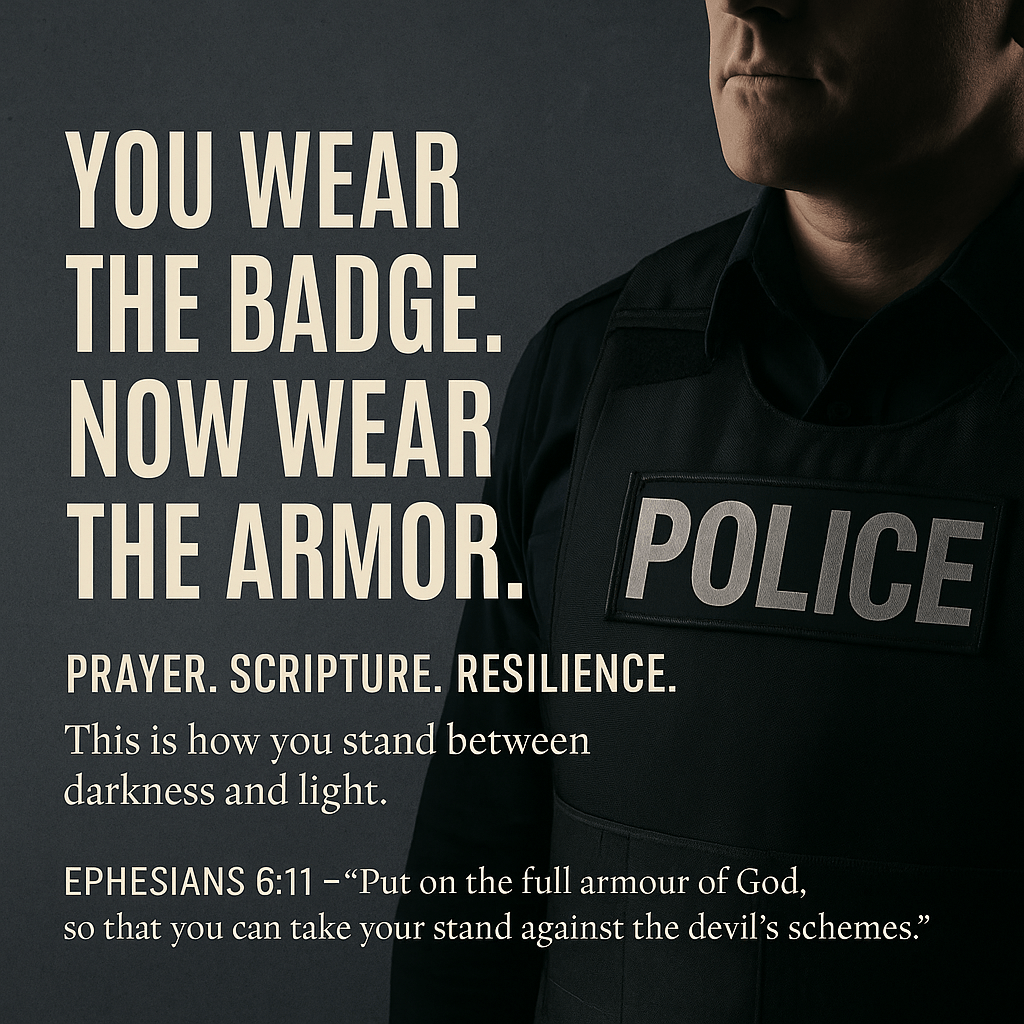
You wear a badge, yes. But when you root yourself in Christ, you also wear righteousness, truth, faith, salvation, and the Word of God (Ephesians 6:10–18). That armor doesn’t just protect you—it transforms you into someone darkness cannot defeat.
Your presence in the streets isn’t random—it’s kingdom work.
And when you walk into chaos with a heart anchored in God, the spiritual atmosphere shifts.
People feel it. Evil senses it. And heaven backs it.
So when the job feels heavy, when the darkness creeps in, remember this:
You were never forsaken in the fight. You were placed in it on purpose.
“The light shines in the darkness, and the darkness has not overcome it.” (John 1:5)
Stand tall. Stand firm.
You carry more than a weapon—you carry the light of the King.
And darkness doesn’t stand a chance.
 Thin Blue Faith
Leave a comment