
Why Right and Wrong Collapse Without a Higher Standard
June 7, 2025
by Mike Crispen
Can someone reject belief in God and still hold to a sense of morality?
It’s a question that has stirred debate for centuries. The idea that morality, without a moral giver, becomes little more than the opinion of the powerful isn’t new—and perhaps there’s something to it. After all, not everyone believes in God… so where does their sense of right and wrong come from? In our world, we often divide humanity into two camps: those who believe in God or a divine interventionist, and those who don’t. The faithful and the secular. The worshipers and the rational. But what if that’s a false division? What if the real dividing line isn’t between belief and unbelief—but between what we believe in and how we worship?
Let’s begin with a simple premise: Everyone believes in a god.
Not necessarily the God of Christianity, Judaism, or Islam, for example—but something they treat as ultimate. It might be a divine Creator, or it might be reason, science, personal freedom, nature, progress, or self. In this broader, secular sense, a “god” is whatever you look to as the highest authority—the source of meaning, morality, purpose, and destiny.
But belief alone isn’t the end of the story.
Everyone worships their god. Not with incense and hymns, but with allegiance, passion, and emotional devotion. If you spend your life defending, promoting, or emotionally investing in something, you’re worshiping it. Even the most militant atheist, when passionately trying to convince others to abandon religion, is evangelizing for a worldview—and defending their god, whether they call it that or not. Let’s logically examine the bold idea that everyone, in some form, believes in a god.
Argument: All Humans Functionally Believe in “a God”
Premise 1: A “god,” in the most general and secular sense, is that which a person believes to be the ultimate source, ground, or governing principle of existence, nature, and destiny.
Premise 2: Every human being holds some belief—explicit or implicit—about the origin of life, the structure of reality, or the ultimate basis for meaning, morality, or truth.
Premise 3: That ultimate belief functions in the same role that “a god” traditionally fills: explaining the cause of the cosmos, the foundation of order, and the authority for values or purpose.
Conclusion: Therefore, every human being believes in something that occupies the role of a “god,” even if it is not called that or understood theistically.
Examples to Illustrate This Idea:
- Theist (e.g., Christian, Muslim, Jew): Believes in a personal Creator-God who governs reality and moral law.
- Pantheist: Believes the universe is god—divine in its totality and self-existence.
- Atheist (Materialist): May deny a deity, but still believes in natural laws or the self-sufficiency of the cosmos as the ultimate reality. In functional terms, the cosmos or physical law takes the god-role.
- Humanist: May reject supernaturalism, but elevates reason, human dignity, or collective progress to an ultimate guiding principle—a kind of secular “divine.”
Objection and Clarification
Objection: “But an atheist doesn’t worship natural law or regard it as personal or moral.”
Response: Maybe not—worship and personhood are expressions of belief in a god, not its defining features. From a functional or philosophical standpoint, the core idea is what governs and explains existence and value, not whether rituals or emotions are attached to it.
This is why I would argue that an atheist engages in a form of worship when they express emotional intensity while arguing against religion. The very effort to persuade others of their belief system reflects devotion. Only the one who remains entirely indifferent—making no attempt to convince others and showing no concern for differing beliefs—can reasonably claim not to worship their chosen worldview, regardless of how their behavior aligns with it.
Yes, one could argue that all humans believe in “a god” if “god” is defined not as a specific divine person, but as that which is ultimate—the source of truth, being, and value. The label may differ (God, nature, the universe, reason, self, etc.), but the role is the same. The philosopher Paul Tillich expressed this when he defined God as “the ground of being” and said, “Whatever concerns a person ultimately is their god.”
He is essentially redefining worship not as singing or kneeling, but as emotional allegiance, intellectual loyalty, and evangelistic behavior—the kind that prompts someone to defend, promote, or attack in service of what they deem ultimate. This broader, more anthropological definition aligns closely with thinkers like:
- Augustine, who said, “Our hearts are restless until they rest in Thee,” implying all humans orient toward something ultimate.
- James K.A. Smith, who argues that we are what we love—that all people worship, whether or not they name it that way.
- David Foster Wallace, who famously said in a secular commencement speech, “Everybody worships. The only choice we get is what to worship.”
So here’s the real question:
Not “Do you believe in God?” but “What is your god?”
Not “Do you worship?” but “What does your life say you worship?”
Everyone places something at the center of their existence. Everyone lives by some standard. Everyone offers their loyalty to a higher cause—whether it’s divine or man-made. These questions are answered by what you devote most of your time to. The object of your greatest devotion will inevitably influence your moral framework, particularly when biblical morality stands in contrast to that chosen object of worship.
But wait—can’t morality still exist without a divine God? Aren’t morals simply part of a social contract, or just a matter of doing what’s right? Let’s put that idea to the test with a thought experiment.
A Thought Experiment: Genius or Evil?
When teaching students about constitutional principles, I often use the following thought experiment to engage their critical thinking processes, and to get them to think through why they believe what they do:
Imagine a man—96 years old. By every Western standard of success, he has triumphed. He is the wealthiest man on Earth. He has influenced global politics, secured his family’s legacy for generations, and built a name that will outlast his life.
But he didn’t do it cleanly. He manipulated laws, destroyed lives, and—even by his own hidden record—committed murder to achieve his ends. Yet he was never caught. Not until the moment before death, when federal agents finally issue arrest warrants. As they tell him he is under arrest, he smiles, closes his eyes, and dies.
Now ask: Was he a genius… or was he evil?
If there is no God—no judgment, no afterlife—then he was, arguably, a genius. He won. He exploited the system, escaped consequence, and secured power. If morality is only the product of social consensus and human law, then what real wrong did he commit if the only price is public opinion?
This raises a deeper question:
If an atheist believes there is no God, no eternity, no divine judgment, and yet chooses to live by rules that limit power, pleasure, or success—aren’t they behaving irrationally? After all, what value does “being good” hold if “good” is defined only by those who happen to be in power or control the narrative?
Ironically, the person of faith—often ridiculed for believing in things unseen—may actually have the more coherent reason for moral restraint. If there is a Judge beyond this world, then there is objective right and wrong. Evil has weight. Sacrifice has meaning. Justice will ultimately be served.
Without that? Then the 96-year-old won. And perhaps we should study him. Shouldn’t we all aim to maximize our personal utility in this short, dust-to-dust life? What sense does it make to sacrifice for the greater good? After all, who really benefits from your sacrifice—certainly not you. That’s quite the moral dilemma.
The Founders Understood This, Too
This is not a new dilemma. The architects of American freedom understood the same tension between liberty and restraint. They believed in protecting freedom—but also in the necessity of religion and moral conviction to preserve it.
John Adams famously declared:
“Our Constitution was made only for a moral and religious people. It is wholly inadequate to the government of any other.”
He wasn’t pointing to piety, but to realism. If humans are not governed by conscience—by a fear of God and a love of good—then external laws alone cannot contain our worst impulses.
George Washington echoed this in his Farewell Address:
“Of all the dispositions and habits which lead to political prosperity, religion and morality are indispensable supports… Let us with caution indulge the supposition that morality can be maintained without religion.”
These men were not perfect. Far from it. Many of the Founders were deeply flawed—slaveholders, power-brokers, and participants in the injustices of their time. But it was precisely this awareness of their own sinful ambition that drove them to create a system of checks and balances, limited powers, and the recognition of natural rights as endowed by a Creator not declared by men.
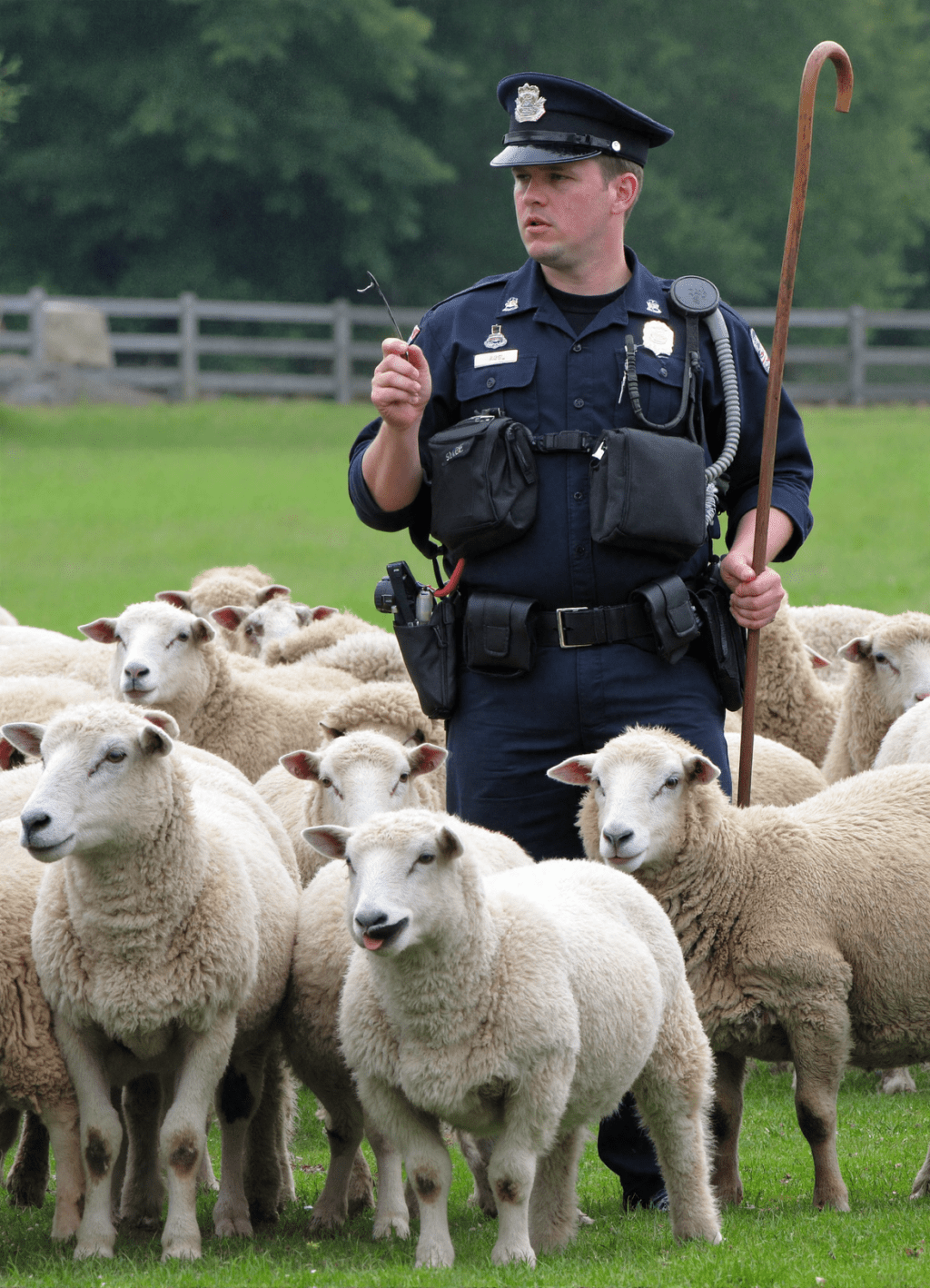
They knew that liberty without moral restraint becomes anarchy. And they understood that restraint only makes sense when individuals believe that they will one day answer to a higher power—not just history or opinion, but God. This is why God has ordained shepherds to watch over the flock—some to lead their souls, and others to protect their physical lives.
To the Shepherds Who Stand in the Gap
This brings us to one final and important note—a thank you to those who live out this moral tension in the real world every day.
To the men and women of law enforcement: your very presence is a reminder that justice is not an abstraction. You stand between order and chaos. You protect life, liberty, and property—not just as enforcers of the law, but as visible instruments of what Scripture calls the “ministers of God for justice” (Romans 13:4).
Your job is more than a profession. It is a moral calling.
Every time you place the safety of others above your own—when you risk your life to protect a stranger, intervene in violence, or stand in defense of someone who cannot stand for themselves—you testify to something higher than evolution, politics, or instinct.
You testify to God.
Because in a godless world, there is no logical reason to value the life of a stranger more than your own. There is no reason to serve, to sacrifice, or to suffer unless you believe in something eternal. Your courage is not just duty—it is evidence. Evidence that something greater than self exists. That justice matters. That evil must be opposed, even when it costs you everything.
So thank you.
You are not merely holding the line. You are reminding the world that there is a line.
And that truth—written not just in books or laws, but in the lives of those who enforce them—is one of the clearest signs that God is real.


 Thin Blue Faith
Leave a comment