
June 17, 2025
by Mike Crispen
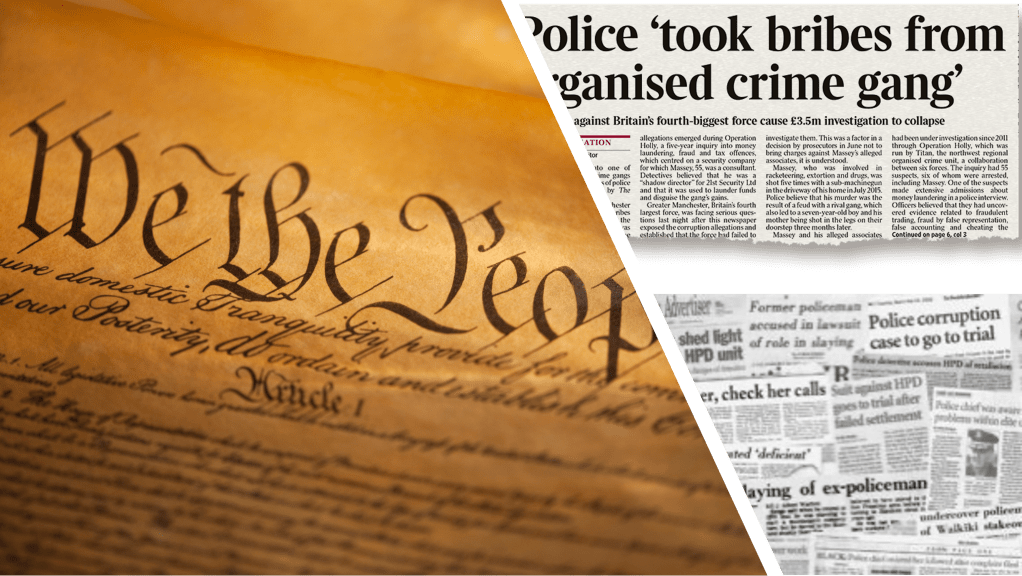
Just this week, a small city in Alabama lost its entire police force after a grand jury uncovered systemic corruption—officers falsifying reports, abusing authority, and violating the public trust they were sworn to protect.
It didn’t happen overnight. Corruption like that grows slowly—through years of unaccountability, unchecked power, and officers who forgot what the badge means. Or maybe they never really understood it to begin with.
I used to ask every class of recruits, every group of police officers, and even some attorneys the same question: “What’s the Fourth Amendment about?”
The answer is almost always the same—“Search and seizure.” That’s what they’ve memorized. That’s what’s been drilled into them.
But that’s not what the Fourth Amendment is really about.
The right of the people to be secure in their persons, houses, papers, and effects, against unreasonable searches and seizures, shall not be violated, and no Warrants shall issue, but upon probable cause, supported by Oath or affirmation, and particularly describing the place to be searched, and the persons or things to be seized.
-emphasis added-
At its core, it’s about something deeper and more important: the right of the people to be secure from unnecessary government intrusion. That’s the point. Not what police can do—but what they shouldn’t. Not how far the state can reach—but where its hands must stop.
It’s a subtle shift in language—but a massive shift in mindset.
Most officers are taught to ask, “Can I search this? Can I seize that?”—as if the Constitution is just a legal user manual for getting evidence. But that’s not what it was written for. It wasn’t written to guide enforcement. It was written to limit it. And if you don’t start there, you miss the entire point of the oath you swore.
I’ve questioned hundreds of police officers over the years, and I’ll be honest—very few have actually read the Constitution. That’s not an attack. It’s a reality. One I think we have to confront if we want to do this job with integrity. Because here’s the truth:
You carry power. Serious power. The kind that can save lives—or quietly erode freedom. And most of us are using it without fully understanding the foundation it rests on.
We’re trained in tactics, laws, and procedures. We know how to make arrests, write reports, and control scenes. But we’re rarely taught to stop and ask: Why do I have this authority in the first place? Who gave it to me? And what limits it?
Why This Matters: The Badge Isn’t Just About Law—It’s About Liberty
Every time you put on the badge, you step into one of the most powerful and delicate roles in a free society. You’re not just enforcing laws. You’re standing at the intersection of liberty and order—two forces that constantly pull against each other.
On one side, there’s the need for safety. People want to walk down the street without fear, protect their property, raise their kids in peace. That’s what laws help provide. But on the other side, there’s the need for freedom—to live without being watched, searched, or harassed by the state. That’s what the Constitution protects.
Your job is to hold the balance. Not tip it.
That’s why knowing the Constitution isn’t optional. It’s essential.
The oath you took wasn’t just a box to tick off in your first week—it was a promise to serve within limits. Not just legal limits, but moral ones. Limits designed to keep power in check. Limits designed to protect the people from the very kind of unchecked force you now have at your fingertips.
Too many officers today see their role purely in terms of control: arrest the bad guys, stop the crime, win the shift. And yes—enforcement is part of the job. But if you see the badge only as a tool for authority, you’re missing the point.
Because in a democracy, the badge doesn’t belong to you. It belongs to the people.
They give you the right to wear it—not as a ruler, but as a steward. Someone who uses their authority to guard the boundaries of liberty—not push them.
The balance isn’t easy. If you lean too far into enforcement, communities start to fear the government. But if you lean too far away, people fear for their safety. Either way, fear wins. And when fear wins, trust dies.
What keeps that balance is a clear understanding of your duty—not just to the law, but to the principles behind the law. That’s what separates the enforcers from the guardians. That’s what keeps your authority from becoming tyranny.
And that’s why you have to start with the Constitution. Not as a checklist. But as a compass.
The Heroic Burden of Policing: Duty, Risk, and Principle
History has always looked to certain people to carry the weight of society’s stability. Soldiers. Reformers. Rescuers. In a modern democracy, that weight falls—quietly, heavily—on the shoulders of law enforcement.
Not because we’re looking for glory. And not because we wear capes. But because when most people run from danger, we run toward it. When most people see chaos, we’re expected to bring order. And when liberty teeters on the edge—either from lawlessness or overreach—we’re the ones expected to hold the line.
That’s a heroic burden. But it’s also a dangerous one.
Because heroism, if it’s not grounded in principle, can slide into something else: ego, unchecked power, or a subtle belief that the ends justify the means.
That’s why I’ve always believed policing isn’t just a profession—it’s a moral calling. One that demands more than tactical skill. It demands diligence.
Diligence doesn’t just mean working hard. It means staying focused on what’s right—even when it’s not convenient. It’s about resisting shortcuts, confronting your own biases, and remembering that you serve something bigger than yourself.
When you swore your oath, you didn’t just promise to enforce the law. You promised to uphold a framework—a set of principles meant to protect both safety and liberty. That means knowing when to act, and just as importantly, knowing when not to.
And make no mistake: in a free society, restraint is often more heroic than action.
This is the paradox of our role. We’re expected to be strong, but not oppressive. Vigilant, but not paranoid. Confident, but not arrogant. It’s not an easy line to walk. But walk it we must—because when we lose that balance, the community loses its trust.
And once trust is gone, policing becomes nothing more than control. That’s not heroism. That’s occupation. And that’s not what the badge is for.
The Three Policing Styles: Proactive, Social, and Balanced—and Why Only One Really Preserves Liberty
Over the years, I’ve seen three general types of officers in this profession. Most fall into one of these buckets—not because they’re trying to, but because the job and their personal attributes pull them that way. How you respond depends on how well you understand what the badge means.
1. The Proactive, Mission-Driven Officer
This officer lives for the chase. They’re always switched on—hunting warrants, stopping cars, watching corners. They know the law, know their powers, and are relentless in pursuit of the bad guys.
Their strengths are clear: they keep crime down, make arrests, and maintain a visible presence. But here’s the risk—they can start to see the job as a game of wins and losses. Every stop is a mission. Every citizen, a potential suspect. Over time, they may stop seeing the people and only see the problems.
And that’s where liberty gets quietly squeezed.
2. The Social, Well-Liked Officer
This one’s the friendly face. They’re at community barbecues, chatting with shop owners, high-fiving kids on the beat. They believe in connection, and they humanize the badge in ways statistics never will.
That’s valuable—especially in communities where trust has been fractured. But the danger is going too soft. When relationships matter more than consistency, enforcement takes a backseat. Crime can creep in. And when that happens, fear replaces trust again—just from a different direction.
3. The Balanced Guardian
This is the hardest role—and the most necessary.
The balanced officer knows when to enforce and when to engage. They don’t chase stats, but they don’t avoid action either. They understand their presence matters—but so does their restraint. They’re not just keeping order. They’re protecting freedom while doing it.
This officer doesn’t stand out at roll call. They may not win awards. But they build something deeper than recognition—they build legitimacy.
And legitimacy is what allows a free society to trust its police.
Because here’s the truth: no community wants to be ruled. And no community wants to be abandoned. What they want—what they need—is an officer who shows up consistently, applies the law fairly, and understands that justice without freedom is just control.
Only the balanced officer delivers that.
How the Constitution Equips You to Balance Force with Freedom
Here’s what the academy rarely tells you: the Constitution isn’t just a document you swear to. It’s a tool—one of the most important you’ll ever carry. More important than your radio. More important than your sidearm.
Because it doesn’t just tell you what you can do. It reminds you what you shouldn’t.
When you truly understand the Constitution—especially its theoretical roots in thinkers like Locke and Montesquieu—you realize it was designed to limit government power. To create boundaries. To protect the people from exactly the kind of unchecked authority you now have.
This doesn’t make you weak. It makes you honorable.
The job of a police officer isn’t to push power as far as it will go. It’s to use it only when necessary, and only in proportion. That’s the difference between a society governed by consent, and one ruled by fear.
Think about the Fourth Amendment again. Most officers are taught it like a tactical rule—”Here’s when you can search. Here’s when you can seize.” But if you see it through the lens of liberty, it’s not about your ability—it’s about their security. It’s about the citizen’s right to be left alone unless the Constitution says otherwise.
That’s the kind of thinking that creates a balanced guardian. An officer who sees the badge not as permission to act, but as a constant reminder to ask why before they do.
It also helps you face those daily grey areas—the ones the academy couldn’t prepare you for. The neighbor dispute that’s legally fine but morally rotten. The questionable call by another officer that didn’t technically cross a line—but left a bad taste. When you’re grounded in the Constitution, you have a clearer lens to navigate those moments—not by instinct or emotion, but by principle.
And that principle is simple: your power exists to protect freedom, not erode it.
Practical Starting Points: What to Read, How to Reflect, What to Discuss
- Read the Constitution. Slowly. Thoughtfully.
Focus especially on the Bill of Rights. Think of them not as tools for enforcement, but as promises to the public. - Study the Founders’ Intent.
Look at the Preamble. Read Federalist Papers 10 and 51. Read Patrick Henry’s warning in the Anti-Federalist Papers. These writings explain why the limits of power matter—and how unchecked authority becomes tyranny. - Reflect on Your Daily Conduct.
Ask: Did I serve the spirit of the Constitution today? Did my actions reflect the values I swore to uphold? - Talk About It.
Start the conversation in your squad car, your briefing room, your academy class. Make constitutional accountability part of your culture—not just legal compliance.
“You can’t protect what you don’t understand—and you can’t honor your oath if you don’t know what it means.”
When you understand the Constitution this way—not as a legal checklist but as a covenant with the public—you begin to see the badge differently. It stops being just a symbol of authority, and starts becoming a symbol of trust.
Finally, The Badge Is Not for Popularity or Power—It’s for Protection
Every time you put on the badge, you make a choice. Not just about how you’ll respond to calls, but about who you’ll be in this profession.
Will you be the enforcer—heavy on control, light on compassion? Will you be the social butterfly—well-liked, always smiling, but often not vigilant enough to even see when protection is needed?
Or will you be something harder, rarer, and far more vital—the balanced guardian?
Because here’s the truth: leaning too far in either direction is a failure of the oath.
The enforcer may follow the letter of the law but forget the spirit of liberty. They risk becoming a symbol of fear instead of protection. But the overly social officer? They do just as much harm in a different way. They build trust—but they don’t back it up with vigilance or action. And eventually, the people who trusted them begin to ask the hardest question of all: Where were you when we needed protection?
Because when crime happens—when families are hurt, homes are broken into, or streets become unsafe—that friendly face becomes a painful reminder of what wasn’t done. The goodwill they built vanishes under the weight of a community that feels abandoned. And trust lost in those moments is hard—sometimes impossible—to rebuild.
One enforces without heart. The other cares without vigilance. Both miss the point.
The public doesn’t need extremes. They need balance. They need officers who can make arrests without becoming oppressive, and build trust without becoming ineffective. Officers who are grounded in principle, not personality.
That’s why the Constitution matters. It’s not a script for one type of policing—it’s the foundation that allows you to be both strong and just. It keeps your power in check and your purpose clear. It reminds you that your authority was never meant for your gain—but for the public’s protection.
So ask yourself: which type of officer are you? Which one are you becoming?
Because in the end, the badge isn’t a reward. It’s a responsibility. And liberty only survives when it’s guarded by those who understand both its power—and its limits.
 Thin Blue Faith
Leave a comment