
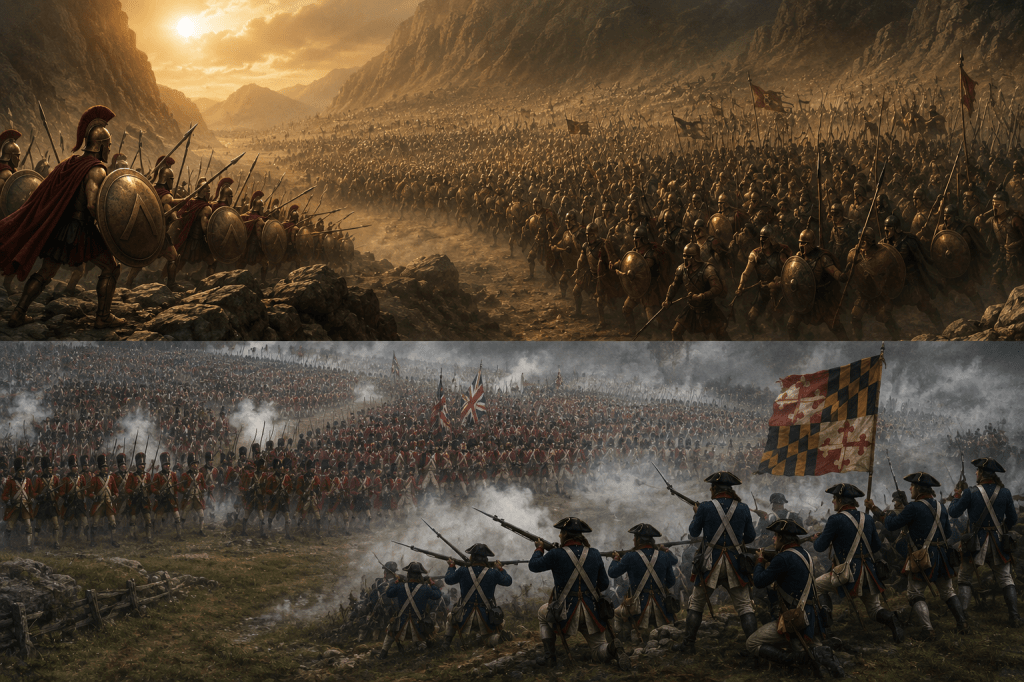
The Story of the Maryland 400, George Washington, and the Providence That Preserved a Nation.
Mike Crispen July 2026
As our nation pauses this week to celebrate the 250th anniversary of the Declaration of Independence, Americans will rightly remember the names that have become synonymous with our founding—Washington, Jefferson, Adams, Franklin, and so many others who risked everything to establish a new nation built upon the revolutionary idea that our rights come not from government, but from God.
Yet behind those familiar names is a story that far too few Americans know. It is a story of extraordinary courage, quiet obedience, and unimaginable sacrifice. It is America’s own Thermopylae.
Most students of history have heard of the 300 Spartans who stood against the Persian army, willingly giving their lives so that Greece might live to fight another day. Less well known are the Maryland soldiers who, on August 27, 1776, marched into nearly certain death outside Brooklyn, New York, buying the precious time George Washington needed to save the Continental Army. Their sacrifice preserved a revolution in its infancy and, perhaps, the very nation whose birthday we celebrate this week.
But the story of the Maryland 400 is also part of a much larger story. Long before those men made their final stand, George Washington’s life became marked by a remarkable series of events that he did not attribute to luck, military genius, or chance. Time and again, when defeat or death appeared inevitable, circumstances unfolded in ways that preserved both his life and, eventually, the American cause. Washington consistently referred to these moments as acts of Providence—the guiding hand of God directing events beyond human understanding.
From the beginning of his military career, Washington’s life seemed to unfold through a remarkable series of events that defied ordinary explanation. As a young officer during the French and Indian War, he accompanied General Edward Braddock on an expedition that ended in one of the greatest military disasters in British colonial history. Braddock was killed, hundreds of soldiers fell, and officers were singled out by enemy marksmen. Yet Washington rode throughout the battle carrying orders across the field despite having two horses shot from beneath him. When the fighting finally ended, four bullet holes were found in his coat, but he had not suffered a single wound.
Only months earlier, while carrying Governor Dinwiddie’s warning to the French in the Ohio Country, Washington had narrowly survived a hostile encounter in the wilderness when an French indian guide tried to assassinate him at close range. At Fort Necessity, his small force found itself surrounded by a superior French army, yet escaped destruction through surrender terms that historians still debate. These events, taken individually, may be explained away. Together, they formed in Washington an enduring belief that the fate of nations ultimately rested in hands greater than those of generals or kings.
That conviction would be tested again in August 1776.
The American Revolution stood on the edge of collapse. The British Army had outflanked Washington’s forces on Long Island and was driving the Continental Army toward the East River. Had Washington’s army been surrounded or captured, the Revolution may well have ended before the Declaration of Independence was even two months old.
Someone had to buy time.
That responsibility fell to a contingent of Maryland troops under the command of Lord Stirling. History remembers them as the Maryland 400, though the number engaged in the final stand was likely somewhat smaller. They were among the best-trained and most disciplined soldiers in Washington’s army. Ordered to hold back a vastly superior British force, they launched repeated attacks against overwhelming odds, fully aware that every charge made their own survival less likely. Their mission was never to win the battle. Their mission was to save the army.
They succeeded.
While the Marylanders held the British at bay, thousands of Continental soldiers withdrew to Brooklyn Heights. That night, an unexpected fog settled over the East River, concealing Washington’s evacuation to Manhattan. By morning, the British discovered that the army they believed trapped had disappeared.
It is tempting to see the fog as the miracle. Perhaps it was. But perhaps the greater miracle was found in the hearts of the men who willingly stayed behind. Providence did not spare them from sacrifice. It worked through their sacrifice. Without their courage, there would have been no army to rescue, no crossing of the Delaware, no Yorktown, and perhaps no United States.
History remembers George Washington, but the Revolution was preserved by ordinary soldiers whose names most Americans will never know. Washington could not have become the leader history celebrates without men willing to carry out a mission that offered little chance of survival. Their faithfulness made his leadership possible.
That principle has not changed.
Every profession needs leaders, but every great leader was first a great follower. Before we are entrusted to lead others, we must first learn humility, discipline, and commitment to a mission larger than ourselves. Following does not mean abandoning independent thought or ignoring wrongdoing. It does mean that once a lawful and ethical course has been chosen, we commit ourselves fully to its success rather than becoming an obstacle to it.
In law enforcement, we are rarely asked to make the kind of sacrifice demanded of the Maryland 400. More often, we are asked to support a difficult decision, embrace change, or place the mission above our own preferences. Those moments may seem small by comparison, but they reveal the same question: Am I committed to myself, or to something greater than myself?
As we celebrate 250 years of American independence, we should remember that liberty was never preserved by famous names alone. It was secured by ordinary men and women who believed the mission was greater than themselves. The Maryland 400 stand among the finest examples of that truth.
George Washington believed that Providence was guiding events far beyond his own understanding. Whether on Braddock’s battlefield, at Fort Necessity, on Long Island, or crossing the Delaware, he saw not merely fortunate circumstances, but the hand of God working through faithful people willing to sacrifice for a greater purpose.
Our nation has never been perfect. The Declaration of Independence proclaimed liberty in 1776, but its promise required another generation to defend and more generations still to fulfill. The sacrifice of the Maryland 400 was echoed nearly ninety years later by the 1st Minnesota at Gettysburg. 262 men commanded to march across a field to stop a thousand confederates – over 80% killed or seriously wounded.
“I saw that in some way five minutes must be gained or we were lost… I knew they must lose heavily… but I would have done it even if I had known every man would be killed. It was a sacrifice that must be made.”
General Winfield Scott Hancock – July 2, 1863
Only 47 survived to fight the next day to repel the infamous “Picket’s Charge” that ended the Battle of Gettysburg. Like the Maryland 400, the 1 Minnesota 262 helped preserve the Union and, ultimately, the path that led to emancipation and the freedom we commemorate each Juneteenth. They followed orders without delay. There was no time for debate. The cause was greater than themselves.
So the next time you’re tempted to measure leadership by popularity or criticize a difficult decision simply because it inconveniences you, remember the Maryland 400. Great leaders are formed through trials, but they are sustained by faithful followers. The strength of a nation, a police department, or any organization ultimately depends on people who are willing to place duty above comfort and the mission above themselves. As our nation struggles again to find it’s way; law enforcement stands in the gap, we call the Thin Blue Line, between anarchy and order. Order is disciple; anarchy is emotion.
As we remember the 250 years of a great nation, let’s recall the great sacrifices of those who stood in the gap. Small numbers against all odds. Providence always seems to favor the few in times like these. Maybe that’s the point of leadership.
Perhaps that is how Providence still works today.
 Thin Blue Faith
Leave a comment